How Ivermectin Actually Kills a Parasite
SEPTEMBER 28, 2026
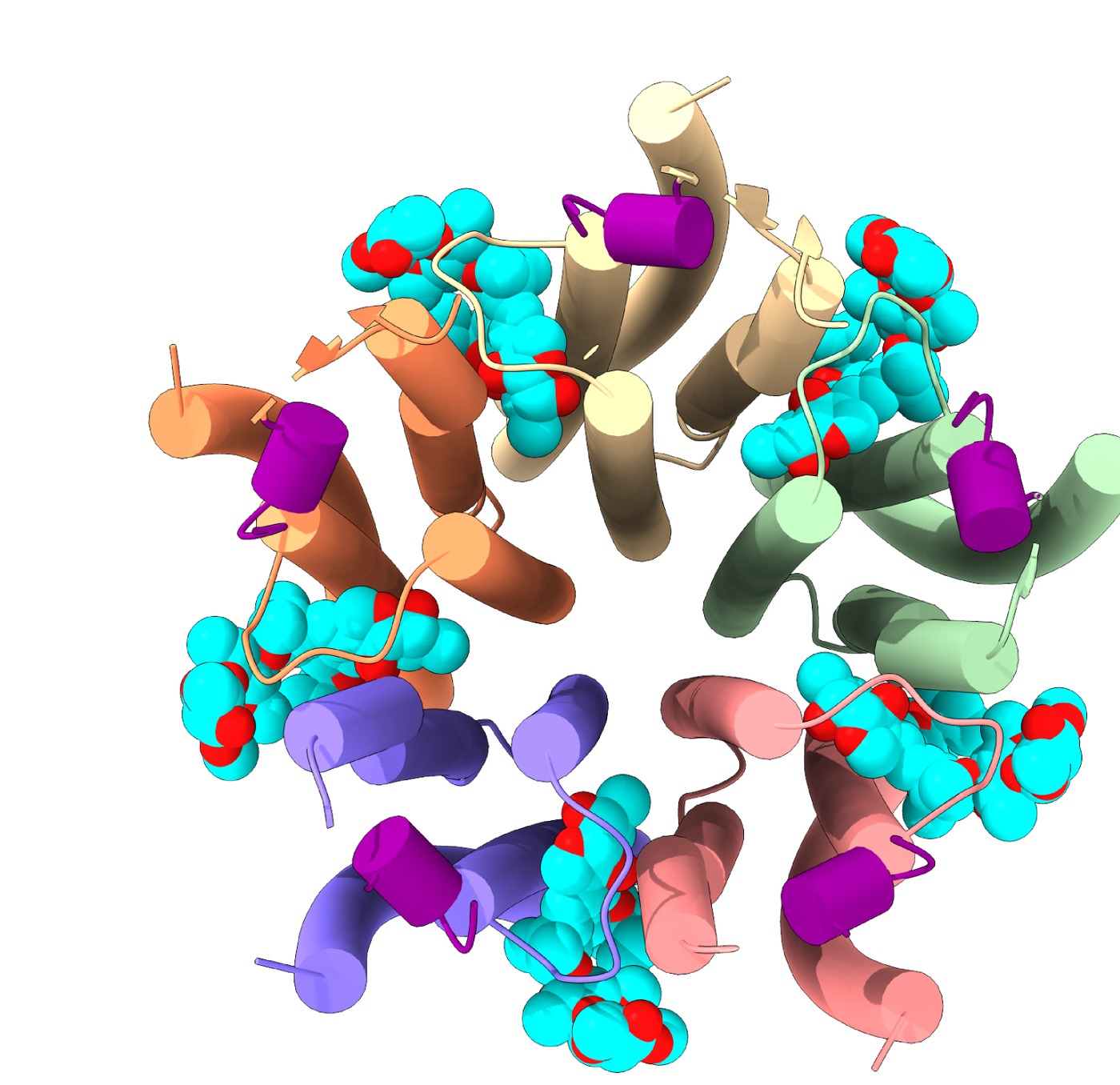
How does ivermectin actually kill a parasite? Not by starving it, and not by poisoning its metabolism. Ivermectin locks open a chloride channel that exists almost exclusively in invertebrate nerve and muscle cells, flooding the cell with chloride until it stops firing — paralyzing the parasite, usually within hours. That's a different target, a different action, and a much faster timeline than a benzimidazole like fenbendazole, even though both end up filed under the same word, "dewormer."
A Channel Vertebrates Mostly Don't Have
Nematode and arthropod nerve and muscle cells carry a receptor called the glutamate-gated chloride channel, or GluCl — five identical subunits arranged in a ring around a central pore, each subunit contributing four membrane-spanning helices to the wall of that pore. Normally the neurotransmitter glutamate binds briefly, the channel opens, chloride ions flow in, and the cell quiets down as part of ordinary signaling — the mechanism behind a parasite's pharyngeal pumping (feeding) and body-wall movement. Vertebrates don't build this particular channel. The closest relatives in a mammal's nervous system are glycine-gated and GABA-gated chloride channels, which look similar in overall shape but differ enough at the binding site that ivermectin binds them far more weakly.
Where Ivermectin Binds, and What It Actually Does There
Ivermectin doesn't compete with glutamate for its usual spot. It wedges into a separate pocket at the interface between two adjacent subunits, in the membrane-spanning region — visible as the cyan molecules seated at every seam in the hero image above, one ivermectin per subunit interface, five per channel. Once lodged there, it doesn't just nudge the channel open the way glutamate does. It locks it open, essentially irreversibly on a physiological timescale, so chloride keeps flowing in continuously instead of in brief, regulated pulses.
Why the Kill Is Fast, Not Slow
That sustained chloride current silences the pharyngeal pump within the parasite's own muscle and nerve cells directly, so a treated worm typically stops feeding and loses muscle tone within hours, not days. Many intestinal nematodes don't die in place so much as lose their grip on the gut wall and get swept out by ordinary peristalsis, paralyzed but still alive when they leave; others die from the combination of paralysis and an inability to feed. Either way, nothing here depends on the parasite running out of an internal fuel reserve the way a benzimidazole-poisoned worm does — the effect is on electrical signaling, and electrical signaling fails fast.
Why This Barely Touches You
Two separate properties keep the effect selective. First, you don't have the target: vertebrates don't build glutamate-gated chloride channels at all, and the mammalian channels closest in shape, glycine- and GABA-gated chloride channels, bind ivermectin far more weakly. Second, even the small residual affinity for your own GABA-gated channels in the central nervous system is kept in check by a second, independent mechanism: an active pump, P-glycoprotein, sitting in the blood-brain barrier and continuously pumping ivermectin back out of brain tissue into the blood. The drug can be circulating in your bloodstream in real quantity and still never build up where it could do something to your own nervous system.
That MDR1 story isn't a hypothetical edge case invoked to illustrate the mechanism — it's how the mechanism was actually confirmed. A subpopulation of collies had long been known to react badly to ivermectin at doses other dogs tolerated easily, and researchers traced it to a specific four-base-pair deletion in the MDR1 gene that introduces a premature stop codon, so dogs homozygous for it never build a working P-glycoprotein pump at all. The mutation runs through the whole collie lineage and related herding breeds. It's a clean natural experiment: break the pump, and the selectivity that protects every other mammal breaks with it.
How Ivermectin and Fenbendazole Actually Differ
Both get called "dewormers" and both are benzimidazole-adjacent enough in public conversation that it's easy to assume they work the same way. They don't. One jams a structural protein and starves the parasite over days; the other locks open an ion channel and paralyzes it within hours. Both are selective because of a target difference, but only ivermectin has a second, active pharmacokinetic guard on top of it.
Ivermectin's Real Track Record, and Where the Claims Outrun It
Ivermectin's discovery traces to a soil sample: Satoshi Ōmura isolated a new Streptomyces bacterium from Japanese soil, William Campbell showed a compound it produced was remarkably effective against parasites in animals, and the derivative they developed, ivermectin, went on to sharply reduce the global burden of onchocerciasis (river blindness) and lymphatic filariasis through mass drug administration campaigns — work that earned both men a share of the 2015 Nobel Prize in Physiology or Medicine. It remains on the WHO's Model List of Essential Medicines for onchocerciasis, strongyloidiasis, and scabies, among other uses.
The COVID-19 repurposing claim is a separate matter, and by now a well-tested one. In ACTIV-6, a large randomized, placebo-controlled outpatient trial, participants took ivermectin 400 µg/kg daily for three days; the median time to sustained recovery was 11 days in both the ivermectin and placebo groups, a hazard ratio of 1.02 that rounds to no effect. Regulators followed the data: the FDA explicitly advises against using ivermectin to treat or prevent COVID-19, and separately warns that the highly concentrated veterinary formulations sold for livestock are dangerous at human scale. The cancer-repurposing claim making the rounds now is at an earlier, thinner stage of exactly the same process: real published lab studies describe ivermectin hitting multiple targets in cancer cells, including drug-resistance pumps and a couple of major growth-signaling pathways, but that's cell-culture and rodent evidence, not a completed human trial.
What the evidence says. The parasite-killing mechanism is well established: ivermectin locks open a chloride channel unique to invertebrate nerve and muscle, paralyzing the parasite within hours, and it's selective because vertebrates lack the target and, on top of that, actively pump the drug back out of the brain. Its record against onchocerciasis, strongyloidiasis and scabies is decades deep and reflected in its place on the WHO's essential medicines list. Its record as a COVID-19 treatment is also settled, in the other direction: a large randomized trial found no benefit, and regulators advise against using it for that purpose. Its case as a cancer treatment is still in the cell-culture-and-rodent stage, not the human-trial stage.
Where I Could Be Wrong
- "Vertebrates don't have this channel" is a strong generalization, not a claim I can trace to a single exhaustive survey. Glutamate-gated chloride channels are described as restricted to invertebrate phyla across the structural and pharmacology literature I found, but I haven't personally verified an absence across every vertebrate tissue.
- ACTIV-6 is one major trial, not the entire evidence base. It's large, randomized, and placebo-controlled, which is why I led with it, but other trials and meta-analyses exist too, and I'm not claiming this single result is the only reason the guidance turned negative.
- The MDR1 deletion's exact prevalence across herding breeds is something I'm describing qualitatively, not with a specific frequency I've verified per breed. The mechanism and the original finding in collies are solid; breed-by-breed numbers vary by source.
- The cancer-repurposing lab studies are real and published, but as with fenbendazole, a molecular target identified in a dish is a reason to run a trial, not evidence the trial would succeed.
Sources
- The Nobel Prize in Physiology or Medicine 2015 — press release, William C. Campbell and Satoshi Ōmura. nobelprize.org
- Wolstenholme AJ. Glutamate-gated chloride channels. Journal of Biological Chemistry, 2012;287(48):40232–40238. doi:10.1074/jbc.R112.406280
- Atif M, Estrada-Mondragon A, Nguyen B, Lynch JW, Keramidas A. Effects of glutamate and ivermectin on single glutamate-gated chloride channels of the parasitic nematode H. contortus. PLOS Pathogens, 2017;13(10):e1006663. doi:10.1371/journal.ppat.1006663
- Mealey KL, Bentjen SA, Gay JM, Cantor GH. Ivermectin sensitivity in collies is associated with a deletion mutation of the mdr1 gene. Pharmacogenetics, 2001;11(8):727–733. pubmed 11692082
- World Health Organization. WHO Model Lists of Essential Medicines — ivermectin, anthelminthics/antifilarials/ectoparasiticides. who.int
- Naggie S, Boulware DR, Lindsell CJ, et al. Effect of Ivermectin vs Placebo on Time to Sustained Recovery in Outpatients With Mild to Moderate COVID-19: A Randomized Clinical Trial. JAMA, 2022;328(16):1595–1603. pubmed 36561174
- U.S. Food and Drug Administration. Why You Should Not Use Ivermectin to Treat or Prevent COVID-19. Consumer Update. fda.gov
- Juarez M, Schcolnik-Cabrera A, Dueñas-Gonzalez A. The multitargeted drug ivermectin: from an antiparasitic agent to a repositioned cancer drug. American Journal of Cancer Research, 2018;8(2):317–331. pubmed 29511601
- RCSB Protein Data Bank. 3RHW / 3RIF — C. elegans glutamate-gated chloride channel (GluCl) in complex with ivermectin. rcsb.org
This is one reader's reading of the research, not medical advice. If something here touches on your own health, take it to a clinician who knows you — and read how these entries are put together.